"Don't Tread on Me"
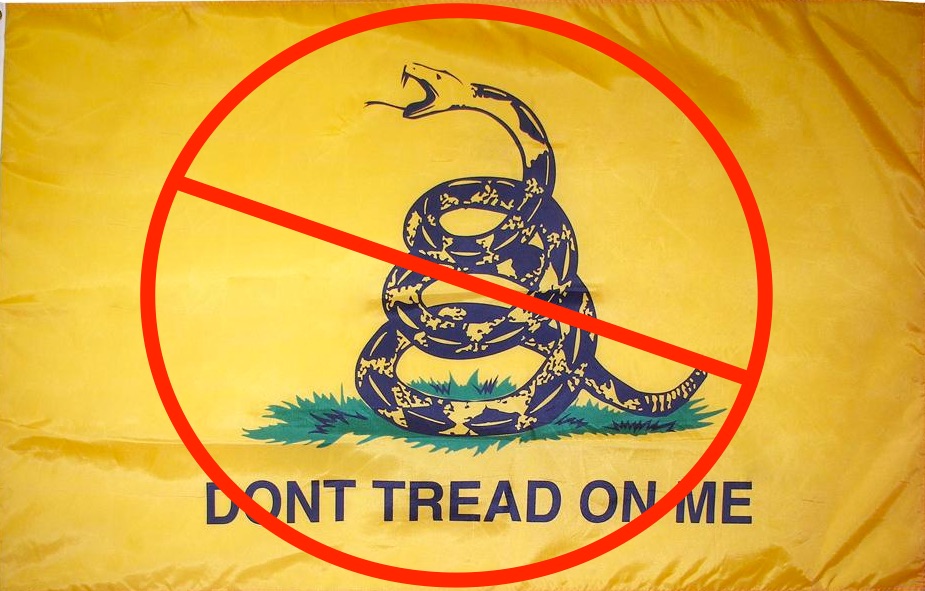
I see that
motto a lot, usually on pick-up trucks. I see flags bearing the phrase when I’m
driving country roads. Today, I saw them on the streets in front of the
Michigan State Capital.
The
implication is that government is walking all over us, crushing our spirit,
controlling our lives.
The motto
dates back to the American Revolution era when England was, in fact, walking
all over the colonists, crushing their spirit and controlling their lives.
The colonists
had real grievances and that flag and motto served the purpose of uniting all
Americans to rise up against their common enemy.
The problem
with commandeering another cause’s slogan is that even if there are some
similarities, no two causes—or their grievances—are alike. Sometimes, slogans
may be hijacked for no other reason than a fondness for a good slogan.
In the first
place, our government isn’t really treading on anyone—not the way the Crown was
treading on the colonists back then. We may not be happy with everything our
governments do, but everything they’re doing is for our welfare, or at least
that appears to be their intention. Some governments are better than others.
I honestly
don’t think any governors enjoy shutting down their state’s economies the way
King George III enjoyed slapping a tax on tea.
Possessing
freedom will not prevent bad things from happening. A freely elected government to
deal with bad things happening did not exist in colonial days. Today, we have a voice
in government. We can change our leaders if we don’t like them.
Accusing
them of treading all over us simply because we don’t like the things they are
doing in behalf of our welfare seems a little extreme.
Protesting
has been in the American DNA from before the revolution right up until this
day. We have always had a voice and never been afraid to use it. What we need,
before we use that voice, is a legitimate cause.
Blacks have
had legitimate causes—demanding their freedom from the bonds of slavery, the
right to vote, access to a justice system that doesn’t discriminate against
them. They have used their voices to demand solutions.
Over the course of our nation’s first century,
woman used their voices to demand universal suffrage. The last century has seen
them fighting for social and economic equality.
Immigrants
have always had to fight to be treated as full-fledged citizens and not just
workers keeping the rest of us happy. They rightly believed they deserved happiness, too.
The LGBTQ
community in recent years have stood up and demanded their voices be heard.
Most recently, high school students have united and gone public with their demands for safer schools and meaningful gun laws. They have been met by 2nd Amendment advocates and gun enthusiasts, using among others, the all-too common “Don’t tread on me,” slogan to protect them from being forced to do things that protect others.
All these groups
have resorted to slogans, peaceful protest, and sometimes in-your-face protests
to actually attain the freedoms they were guaranteed. They may have carried
flags or signs saying, “Don’t tread on me,” but generally their demands were more
specific.
“Don’t tread
on me” is just too damn easy. It’s nothing short of laziness on the part of
people who simply don’t like being told what to do by elective representatives,
the very right we fought for and won in the Revolutionary War. Those
forefathers waging that fight did so with the nation’s welfare in mind, not
their own.
“Don’t tread
on me,” morphs into a pitiful, “Don’t pick on me,” when offered up by one group
in America that has never been picked upon.
Whenever I
see a young white male at the wheel of a pickup with a gun rack in the back and
a “Don’t tread on me” sticker on the window, or marching in front of a State
House carrying a “Don’t tread on me” flag, my immediate thought, is “Give me a
break.”
Don’t
plagiarize real patriots from three centuries ago. Tell me what you want. Do
you want the right to die from a disease that can only reach you through one of
your co-workers? Do you really want the freedom to put your family
at risk, because you’re tired of elective officials telling you what to do? Do
you think your forefathers risked everything so you could have the right to
risk everything?
Carrying “Don’t
Tread on Me” flags make as much sense as reviving and carrying around signs bearing the “Lock
Her Up” slogan. Sadly, those lame signs could also be found at the Michigan
protest. What I didn’t see anywhere was the Michigan state flag, which contains the Latin word “Tuebor.” Tuebor means, I will protect. I wonder how many protesters are aware of this.
It’s enough
to make one long for the good old days of 1776, when protesters not only had
legitimate grievances, but were willing to take real risk to find solutions to
those grievances; not just make noise. They also had creative and original slogans to support their
cause, not 300-year-old retreads.
No one is
treading on you. People smarter than you are merely trying to protect you, to save your life.

