Friday, December 28, 2012

Poverty and Trips to Idaho

I wrote this story over 20 years ago when I worked for the Postal Service. Some of the incidents actually took place. Well, possibly just one incident. But in the ensuing 20 years, one thing hasn’t changed. Many Americans can’t get the idea out of their heads that poor people are screwing us. My only question is this. If they’ve been screwing us for this long, why aren’t they doing better?
  

    It’s that time of the year when offices start collecting for Christmas care packages for the needy. At my workplace, in addition to asking for non-perishable canned goods, we were also asked if we knew of any needy families on our route that might benefit from our generosity. The request came with one caveat.

“Make sure the families are truly needy,” we were cautioned. One year we brought food to a home and the family was away on vacation to Idaho.”

This seemed rather strange to me. I never took vacationing in Idaho to be a measure of one’s financial well-being or not-so-well-being, and yet the implication clearly was that the truly poor would not be vacationing there.

I don’t know. Having vacationed in Washington D.C., Boston and other tourist hotspots, I’d look at Idaho as a pretty cheap getaway, all things considered. I have never heard anyone say, “We’d like to go to Idaho this year, but I don’t think we can afford it.”

I generally set an income level of 15 to 20 thousand a year for a family of four as being in the struggling range and below that to be poverty. But maybe I’m naïve to be considering poverty based solely on economic indicators. 

Maybe there is something to be said for the Idaho/poverty connection. I checked out some books from the library and sure enough Idaho has one of the lowest number of people living off Uncle Sam.

So if you can’t live there and be in poverty, it stands to reason you shouldn’t be able to visit there either and be in poverty. You can’t have it both ways. Therefore it makes sense that you wouldn’t want to be giving someone visiting Idaho a Christmas care package. Or anything else for that matter.

I’m very careful about this now that I know. Like they say, a little bit of knowledge goes a long way—maybe not as far as Idaho but still a long way.

I was walking into a neighborhood K-mart the other day and there was a Salvation Army soldier manning the post. I walked over to him and casually struck up a conversation.

“I was just wondering,” I said, “but you don’t happen to know if this money or any of the stuff you buy with this money goes to people who vacation in Idaho, do you?”

He looked real smug, like he knew where I was coming from but at the same time didn’t want to be bothered—like he had seen me coming or something. He stepped back and pointed to a sign taped to his pot. It read: WE DON’T GIVE NO MONEY, NO HOW TO PEOPLE WHO VACATION IN IDAHO.

“Satisfied?” he asked.

“Very much so,” I replied, “and impressed I might add.”

“Well, let’s put some of the green stuff into the pot then.”

“Wait a minute,” I said. “Not so quick. Being satisfied and being willing to part with my hard earned cash are two different things. You know, I watch a lot of 60-minutes, so I’m not exactly walking around in a vacuum. I know there is a lot of fraud going around, especially amongst the poor. You read the papers, don’t you?”

“What are you getting at?” he asked, a little impatiently.

“How do you know,” I said rather deliberately so as to make my point perfectly clear, “that some woman doesn’t tell you that her family never visits Idaho and then after you’ve given her a turkey and a week’s supply of canned peas they don’t pack up and hit the road. How-do-you-know, eh, how-do-you-know?”

“I don’t know, I’ll ask her.”

“You don’t think she’d lie to you if she wanted the turkey bad enough? Maybe you should have her sign an affidavit.”

“Stating what?”

“That they aren’t going to Idaho.”

“Never, ever? For how long?”

“For as long as they want to be treated as poor people.”

“And maybe, I could drop you right where you stand,” he said, sounding not so much like a Salvation Army soldier but more like a real soldier.

I wasn’t taking any chances. I dropped a buck in the pot and took off. Still, something has to be done about this Idaho problem. I’m just not exactly sure what but something has to be done.

I’ll tell you what I would like to do, though. I’d like to take a trip to Idaho over the holidays. Then I could send postcards to all my friends.

“Merry Christmas from Idaho,” I could write. “Wish you were here. Wish you could afford to be here.”
 
I’d be the envy of all my friends. “Man, that Phil has it made,” they’d say. “He’s doing Christmas in Idaho. He must be rich.”


Monday, December 3, 2012

Pearl Harbor Day 1982, Hope for the Holidays

I left Vietnam in July 1971 and the Army in January 1973. For the next few years I lived in San Pedro and Long Beach, California; Rochester, New York; and Kill Devil Hills, North Carolina before settling in Virginia Beach, Virginia. Somewhere in the middle of all that moving around I got married and by 1982 I was the father of two girls. I had done a little writing while living in California but not that much and I had reflected back on Vietnam even less. But by 1982 I was ready to take look back  , not just on Vietnam but also on just about everything else.


Hope For the Holidays
                     --a GI remembers
                           Virginian Pilot, Tuesday, December 7, 1982


In December 1970, I was nearing the end of my first year in the army. It was a strange year. I held none of the then-popular objections to serving in the army. Both my parents had served their country during World War II and I was proud to be following in their footsteps.

But there was one problem. I didn’t really feel that I was walking the same path that they had. So many changes had taken place and the army had come under so much attack in recent years that it was hard to believe that my army was my father’s army. His had had the support of the entire nation. Mine didn’t even have the support of its own members. After one year I was still looking for the missing link.

But as the year was drawing to a close it was the upcoming Bob Hope Christmas Show that occupied my thoughts more than anything else as the 12 days of Christmas passed so tediously slow.

I was an information specialist assigned to the 1st Aviation Brigade. We’d be in charge of taking the official pictures of the show—Hope, the girls, the celebrities, the girls—did I mention the girls.

Saturday, November 10, 2012

Hey, I Wrote That


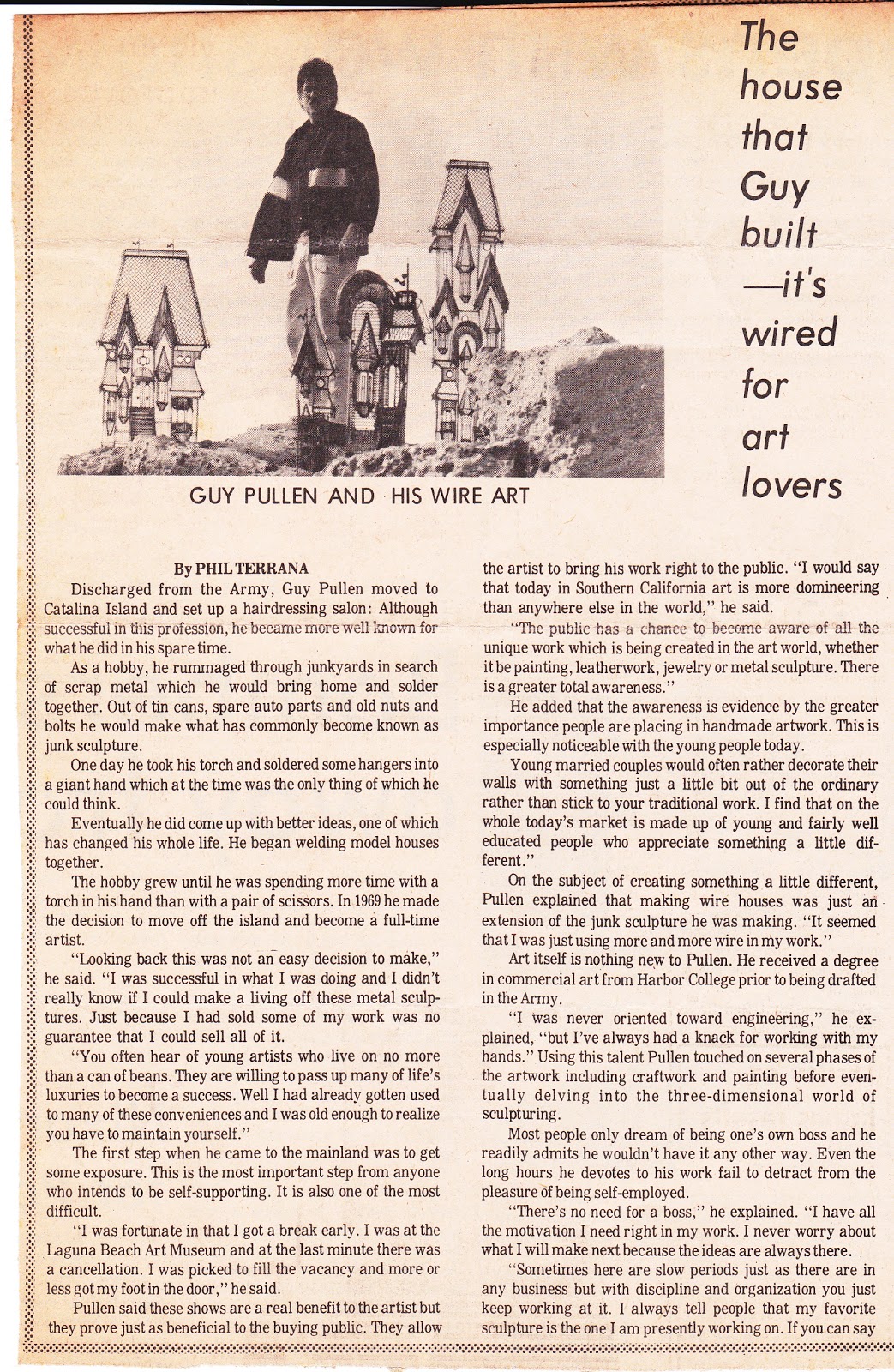
In the last few months before I left the army, my commander, Col. Archie S. Cannon got me a position with the San Pedro News-Pilot, because he knew I wanted to be a writer. I wrote mostly obituaries but was sent out on a few assignments. One was to interview Guy Pullen, a hairdresser turned artist who created sculptures out of the wire and junk he found in landfills.  I drove to his house in Palos Verdes and conducted a very nice interview. As I was leaving he gave me a wire house he was working on.

I’ve carried that house with me for over 40 years, sometimes hanging it in my own homes, including my current one in Virginia Beach and sometimes simply storing it away in the attic or closet. Recently I gave it to my daughter, Danielle, who always liked it. And that was that until...

Tuesday, September 25, 2012

Amelia Earhart Luggage


I never really did understand the reasoning that went into naming Amelia Earhart Luggage. I mean, what was the point? Seriously?
 
About seven years before her plane crashed in the Pacific or possibly was stolen in mid-flight by aliens, she crashed another plane on this day, September 25, 1930 at the Hampton Roads Naval Air Station.
 
Later that night at a dinner party she made light of the accident saying, “It was just one of those little things.”—Like a bump in the road, perhaps.
 
If Mitt Romney had been alive then and running for—I don’t know—maybe pilot-in-chief, he might have been heard to exclaim, “Just a little thing! Just a little thing! My God, her plane flipped over and she calls it just a little thing. How out of touch can one person be?”
 
Anyway, when I realized that today was the anniversary of that crash I went looking into my archives—a box labeled “Rejected Stuff.” This was a letter written to the Virginian-Pilot on May 8, 1979, just a few months after we had moved to Virginia Beach.

 
Editor, Virginian-Pilot:

This month’s giveaway at a local bank is a beautiful matching set of Amelia Earhart luggage—“Something to hold your dreams.” It’s good to know someone has a sense of humor although the last people I would have suspected would be the banks.

The possibilities for Amelia Earhart luggage are endless:
 
Say your mother-in-law came over for dinner one night and never left; and that was six months ago! Give her a beautiful matching set of Amelia Earhart luggage for Mother’s Day and kiss her goodbye forever.
 
Say you borrowed $500 from a friend and now he’s beginning to threaten you. Don’t fret. Borrow another thousand and send him on an all-expense paid trip to Pago Pago with his brand new matching set of Amelia Earhart luggage. Watch your money problems fly out the window.
 
Say the 9 to 5 rat race has you beat and you want to get away from it all. Buy yourself a beautiful set of Amelia Earhart luggage and say goodbye to your workday blues.

And say, it you feel your mother-in-law or friend might get bored on their upcoming excursions, why not pack a handsome surprise in their brand new Amelia Earhart Luggage? How about a copy of Wiley Post's Come Fly With Me?
 

Monday, September 3, 2012

The Young Girl, the Salmon and the Genie


This was my entry for the Writers Weekly Summer 24-hour contest, which took place on the same day that grandson Brayden made his appearance into the world. I received an honorable mention for the story as did daughter, Danielle for her story "Something Special." July 15, 2012 was a fine day all around. The prompt for the story was the first paragraph ending with the words, "and she dropped her knife...


Growing up on a fishing boat docked in this small northwest coastal town brought stares from townspeople and jeers from classmates. She desperately wanted to escape but, with competitors driving down charter prices, she knew her dad would never be able to afford a replacement. As she sliced open the Salmon, her eyes widened and she dropped her knife

Monday, August 20, 2012

So, this is about the word, so

This article was published in the August 19 Virginian-Pilot Forum section most likely because the paper felt everyone needed a break from politics. I don't know if anyone else has observed this trend but I have been hearing it everywhere.
The article was accompanied by a picture of Hope Solo and a caption that read: "So, apparently, it's 'Hope Solo,' not 'So Lo.'"


So, this is about the word, so
 
So I was listening to an interview today on television, which reinforced for me that a brand new fad is combing the country.

So you might ask, “So what is this revolutionary craze sweeping the nation, and possibly the world?"

So I will tell you. “So” is it.

So what is it, you ask?

“So” is it, I tell you. So let me explain.
 
So what I am noticing is that every day more questions being asked by interviewers are being answered by statements beginning with the word “so”.
 
So maybe you are thinking that this might be simply a case of Beverly Hills teenage valley girls speak and surely not the way the civilized folks speak.
 
So you would be wrong to assume this. So let me tell you how widespread this so-so new way of talking has become.
So I have heard economists begin every sentence with so. So I have heard Congressmen, diplomats and scientists begin every sentence with so.
 
So, today, an astronaut talking about the vehicle that will land in a few hours on the planet Mars, described what would happen in these words.
 
“So the modular carrying the rover will hit the Mars atmosphere. So when it does a parachute will deploy and—”
 
So, and so what?
 
So what happens next isn’t really important.
So what is important is why does every sentence have to begin with the word “so?”
 
So didn’t we already go through this nightmare with the word “like?”
So didn’t we learn our lesson?
So who starts these trends?
 
So I think maybe some public relations firm must hear someone, somewhere start a sentence with “so” and decide that it sounds just different enough to make ordinary sentences and ideas a little more appealing and so it starts advising its clients to employ this unique new way of talking but then other public relations firms latch on to the idea and it starts spreading like so many cultured cells in a Petri dish.
 
So some people even hear it on their own and are attracted to it like so many flies to flypaper and before you know it, every Tom, Dick and Harry so and so is starting every stupid sentence with “so.”
 
So I was wondering if this was simply an American thing or if the whole world had jumped on the “so” bandwagon. So I turned to London where the Olympics, the largest international gathering of athletes were taking place.
So I hear an interviewer ask a girl on the Mexican soccer team who does she think is the best female soccer goalie in the world at this time.
 
“Solo,” she answers cautiously, perhaps not wanting to offend her own goalkeeper.”
 
So I am at a complete loss because for the life of me I have never heard of a soccer goalie named Lo.


Thursday, August 9, 2012

September 1973: An Up and Down Month


This story was published this week by the The Whistling Fire web magazine. It describes two events that happened within the space of a few weeks back in September 1973. Hell on Earth, a love story is all about seemingly unrelated events proving eventually to be significant.
The novels Postal Service and Hell on Earth, a love story and my 30-year career in the Postal Service were the result of events set into motion in September 1973—a real up and down month, but a very significant one.


September 1973: An Up and Down Month
                                                                            September 5, 1973—Began classes at Cal State Long Beach

I hadn’t really expected to be going back to school.  God knows my time at Lowell Tech had been long enough and the five years I spent there hadn’t kept me out of Vietnam or gotten me a job.
 
 For sure it was a good experience but I think everyone, including myself, was hoping for more.  I don’t mean that in a bad way. Hell, hoping for more is the driving force that pushes us all. And when the more isn’t what you expect it to be then you hope for something else.

This Teaching Credential Program at Cal State Long Beach was that something else.  Things were finally coming together.  This time I was majoring in something I actually believed in.  And I was sure it would lead to a job and an opportunity to continue writing.  At last, I would be able to look my father in the eye and we would both know that everything was going to be all right.

What he had said the morning I left for boot camp at Fort Dix was still fresh in my mind.

 “I hope the army makes a man out of you,” he said, frustrated by my lack of direction. I have to admit, he had a point.

 “I hope so, too,” was my understated response.

So I went to Vietnam, did some writing for a military magazine and did the soldier thing in the form of guard duty on the third security ring around the Bien Hoa Airfield.  The general feeling was that if anyone got through the first two rings they’d have to be really good and we weren’t going to stop them no way, no how.  Still they gave us M-16’s and the code word of the day.

By the time I got out of the army I was more than ready to get back on the road to my future—a journey I has first started in 1964 and detoured from so many times I was losing count. That’s why I was returning to school. Only this time the plan wasn’t to go to college. This time I was going to college with a plan.