Thursday, March 14, 2013

Robots present - Watch your language


In my last blog I wrote about a letter that was sent to the editor and published but not before some editing took place that nullified the purpose for sending the letter in the first place. It was unfortunate but I understood. 

Almost every letter is edited in some way—to save space, to protect the innocent, to keep the letters civilized. I’ve come to accept this and actually expect it. It allows me to say what I mean, knowing that the editor will protect me. But some times I just don’t get it. 

There was an article recently, “Robots going into labor” by Cecelia Kang of the Washington Post about robots playing an even bigger role in the workplace. There were robots, the article said, that actually managed other robots—and they were increasing in number every day.

This was my take on the subject, which I sent to the editor: 

This is a wonderful story that can only make us all feel better about the future. Apparently that future will be one where American companies will consist of a lot of robots working their ash cans off and one CEO depositing the profits with a check he makes out to himself. But wait, don't we already have machines that can sign documents? How ironic and yet at the same time, refreshing. A CEO in the unemployment lines. 

And this is what the editor published under the title,  

Their pay? A can of oil.

This is a wonderful story that can only make us all feel better about the future. Apparently that future will be one where American companies will consist of a lot of robots working very hard and one CEO depositing the profits with a check he makes out to himself. Butwait, don't we already have machines that can sign documents? How refreshing: a CEO in the unemployment lines.

The edit at the end was okay because it didn’t change the story. But changing “a lot of robots working their ash cans off” to “a lot of robots working very hard” is a little discomforting. Obviously I was going for the cheap laugh intending “working their ash cans off,” as a substitute for the more familiar “working their butts off” while associating robots in some way with the tin man, or to go one step further with a metal trash can.

Okay, I was trying to insult the robot in any childish way I could and yes, I know that is stupid because even though a robot can do a lot of things they can’t really be insulted—although the original article states that they can be designed to appear to exhibit real emotions like looking sad, confused and I suppose being insulted.


Anyway, I question where we have come as a society. Robots replacing workers is bad enough but not being able to joke them is going to take all the fun out of going to work.

Tuesday, February 12, 2013

Sorry Asher, I Tried

 My fourth grandchild was recently born to my daughter Danielle and her husband Chris. They named him Asher Jackson and he was born just after midnight. The next morning one of the nurses brought in the daily paper to save as a memento of what else was happening on the day of his birth.

As might probably be true for a lot of kids being born these days, the headline was not that good nor was it inspiring. Then again, that might hold true in the cases of every child born in every generation since headlines generally tend to be more dire than uplifting.

I wanted to give him a better newspaper experience than the Culpepper Star-Exponent had provided him. A few days after returning home I saw my opportunity and wrote the following letter to the editor of the Virginian-Pilot. It was a chance for Asher to get his name in print and also someday look back to recall (fondly, I hope) that his grandfather was one of those old cranks that were always writing letters to the editor complaining about one thing or another. I entitled it,
                         
Don't Blame Asher.

Re “Price of gas here skyrockets this week” (businessday, Feb. 5): I learned in the paper today that gas prices have spiked again in just the last few days. That’s like going out to the driveway to get the paper and reading the headline, “Sun Came Up This Morning.” Tell me something I don’t already know.

Tell me why the price is higher and why it rose so quickly. And telling me it is because the price of oil has gone up won’t cut it. Let’s put a little pressure on the petroleum industry to explain them selves.

Last week I drove up to Culpepper for the birth of my grandson. Before I left I filled my gas tank with $3.16 per gallon gasoline. Two days later, when I began my return trip home, gasoline had risen to $3.39.

I know that the birth of Asher Jackson adds one more consumer to a world already burdened by a shortage of resources. But the kid is just 8 pounds and won’t be driving for another 16 years. Certainly we can’t blame him for the price increase even though it coincided with his birth.

So tell me, whom do I blame?


As luck would have it the letter got in only they left something out—specifically all the stuff about Asher. Now when he looks back he will only see an editorial in which I am again complaining about gas prices, much as I did in another editorial back in October 2005. He really will think I'm an old crank and he just may be right.

The one thing I do know for sure is despite what any headline might say; the arrival of Asher Jackson was the best thing happening on January 30, 2013.


Tuesday, January 22, 2013

Philadelphia, San Pedro de Macoris, and Extremadura


When asked why he robbed banks, Willie Sutton answered, “because that is where the money is.” It is easy to see why a group consisting mainly of bank robbers would be found mainly around banks.


What’s more interesting though is how a group that somehow winds up everywhere would originate from the same place—especially when they aren’t acting as a group but rather individually. It would be comparable to all the bank robbers in the country coming from the same town. We’d have to wonder what was in the drinking water. 


Take the cities of Philadelphia, San Pedro de Macoris in the Dominican Republic, and the arid, sparsley populated area of Extremadura in western Spain. These three locations would have a profound effect in three distinct areas of human accomplishments based simply on the unusually high concentration of its citizens involved in those  endeavors.<

Tuesday, January 8, 2013

The Laffer Curve

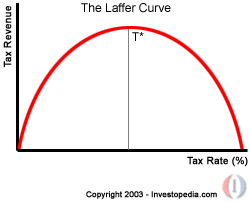
Supply-side economics sometimes referred to as Reaganomics, which in turn has been referred to as “Voodoo Economics” is most often explained by the Laffer Curve credited to a young economist named Arthur Laffer. Some stories suggest that while discussing economic theory at a restaurant with some friends Arthur suddenly took a napkin and drew what became known as the Laffer Curve.


Laffer Curve


Another curve, which could be used to describe the success rates of great ideas first written down on restaurant napkins, might look like this.

Anyway, getting back to the Laffer Curve. The premise is that tax revenue would be zero when the tax rate is 0%, for obvious reasons and also when it is 100%, because there would be no incentive to earn money if it was all going to be taxed. This makes sense.


But Arthur concluded, rather arbitrarily and possible because the restaurant was closing, that these two points had to be connected by a line, which he decided should be a curve. Because a curve has an upslope and a down slope, he concluded that the most tax revenue would be collected when the curve was at its high point and any tax rate higher than this would result in lower revenue.

My problem is this. Why does there have to be a curve connecting those two points and who determines the arbitrary high point. Other than at the 0-mark and 100%-mark, I don’t see the connection between tax rate and tax revenue. The money workers earn and the profits investors make is dictated more by what they get then what they pay out. Take an entrepreneur who makes a million dollars a year but because of a 90% tax rate only gets to keep $100,000. Would he get out of the business and get a job flipping hamburgers because he get to keep all of the $10,000 he makes doing that?

If a person or a company can make so much money, whatever the amount is, why does the tax rate matter, other than at the two extremes? If money were being made, then most people and companies would see that as a good thing, something worthy of continued pursuit. To refuse income because more of it might be taxed seems to be foolhardy and shortsighted.

Now probably the tax-rate area close to 0% and 100% would mimic those two points. But to say 35% or 55% or 75% is going to result in an automatic shutdown of the economy makes no sense. Greedy people might want as much as they can get but I don’t see greedy people saying if I can’t have all or most of it I don’t want any at all. Greedy people do want as much as they can get whatever that amount might be and we sell them short to think they would pull out just because they can’t have it all or even most of it.

We might be able to look back and determine that exact point in time when greedy individuals gave up being greedy because there just wasn’t enough incentive but I don’t think we can predict when it will happen in the future or what event will cause it.

So this is the way my curve would look.


The space in the middle is missing because we just don’t know. It could be a line, a curve, or a series of dots. But I don’t think that area in the middle can tell us anything about what people are or are not willing to pay in taxes.


And if it doesn’t tell us that, then it can’t tell us much about what they’re willing to earn or not willing to earn before they call it a day and drop out of the system.


Friday, January 4, 2013

More Guns? Really!

A slightly different version of this editorial, containing a little less of the sarcasm, was published New Year's Day in the Virginia Pilot under the heading, PUTTING AN END TO THE GUN CULTURE, A good New Year's resolution for the nation would be to make some progress on this matter.


Cowards will do what cowards are going to do.

In the old west, a period many Americans wouldn’t mind returning to, the most vile act a man could commit was to shoot someone in the back. Only cowards did this. I know this from growing up watching TV westerns in the 1950’s; another period many Americans wouldn’t mind returning to.

The point is cowards look for an advantage. That’s what they do. The NRA suggests that if everyone carried a gun then the scales would once again be balanced and all would be right in the world.

But scales don’t stay balanced for long. Whether its politics, athletics, business or just your run-of-the-mill need for violence, the key has always been to find an edge.

Cowards with guns do what they do because they have an edge—the gun. The problem is that if everyone carried a gun the cowards would simply have to find another edge—body armor, a bigger gun, a faster bullet or, if push came to shove and with violence it always does, they would have to start shooting people in the back.

More guns are simply not the answer.

A Tea Party with Nothing to Celebrate

This was written a few years back when the Tea Party was beginning to make its mark and basking in the glories of 1776 was the thing to do. What we are beginning to realize now is that the Tea Party is capable of doing nothing. They are a roadblock. 

From what I have been able to gather, when our forefathers gathered themselves together, they came up with great ideas. It doesn’t seem like they spent a lot of time talking about the great ideas that came before them although they were certainly aware of them. But they seemed hell bent on making their own mark in history.

Many of today’s leaders, and few seem destined to ever be called forefathers of anything, seem hell bent on returning to the days of yesteryear. Their followers are marching right behind them, tapping their feet and clicking their heals, on this journey down the yellow-brick-road back to the good old days.

But those good old days weren’t as good as they were cracked up to be. And while many of the improvements of the last 200 years have come from the great free enterprise system created by those forefathers, just as many advancements have come from the government they put in place.

Going back in time is as fruitless as continually degrading progressives as if the alternative to progressive is something worth striving for.

The problems we have today are problems we have brought on ourselves and they are only problems because we have allowed them to become so. We can blame government all we want but this is the nasty little secret: We are the government and we want a lot. The problem is we all want different things.

Our forefathers wouldn’t even recognize the nation they created. Paved highways going to every corner of the country, buildings a thousand feet tall, oil wells two miles deep, a space station floating 150 miles in space and microscopic atoms being split in two and used to power cities. Medicines to cure every ailment, farms almost as big as the state of Rhode Island, fifty thousand people leaving their homes, getting in their cars and driving to a football game fifty miles away and then returning to their home the same day.

Our forefathers wouldn’t know where to begin to solve today’s problems, though in all honesty I think they would make a better effort. At the very least they would push for compromise. So why does a small segment of our society insist that going back to the world of our forefathers is the answer to today’s ills? In all likelihood, given the complexity of today's world, our forefather would probably be astonished that the government isn’t bigger than it is.

Wearing three-cornered hats is cute and waving 1776 flags can be fun but anyone who thinks that solving today’s woes is all about shrinking the government and then waiting for everything to fall into place is nuttier than King George III was when he thought the men leading the revolution were a bunch of country bumpkins. We are a bigger nation with bigger problems in need of bigger solutions

Another thing about the forefathers. They had more on their minds than winning the next election or retaining their leadership post. That is the real reason we still talk about them today.

Wednesday, January 2, 2013

Christmas Greetings


I’m not very good about sending out Christmas cards. That’s an understatement. I’m terrible at it. That being said, it’s always nice when I receive a card that I wasn’t expecting.

Kath and I recently bought a small second house in Richmond that would make it easier to visit our daughters who live with their families in Richmond and Culpepper. But before it gets easier there is work to do—tear down the ceilings and tear up the floors and paint everything in between.

A few days before Christmas I was doing what my kids probably think I was born to do—attacking a house with a crowbar and a hammer. I have to admit that in spite of mess—plaster, insulation, and unfathomable dust everywhere I was having a pretty good time.

I was recalling, as I like to do, the demolition work I did as a college student at the Powers Hotel in Rochester. There is hardly a more fun job than being given a crowbar and sledgehammer, shown a room and told to take it down. I had my CD’s playing and was engrossed in my little world that was literally falling apart all around me—in a good way.

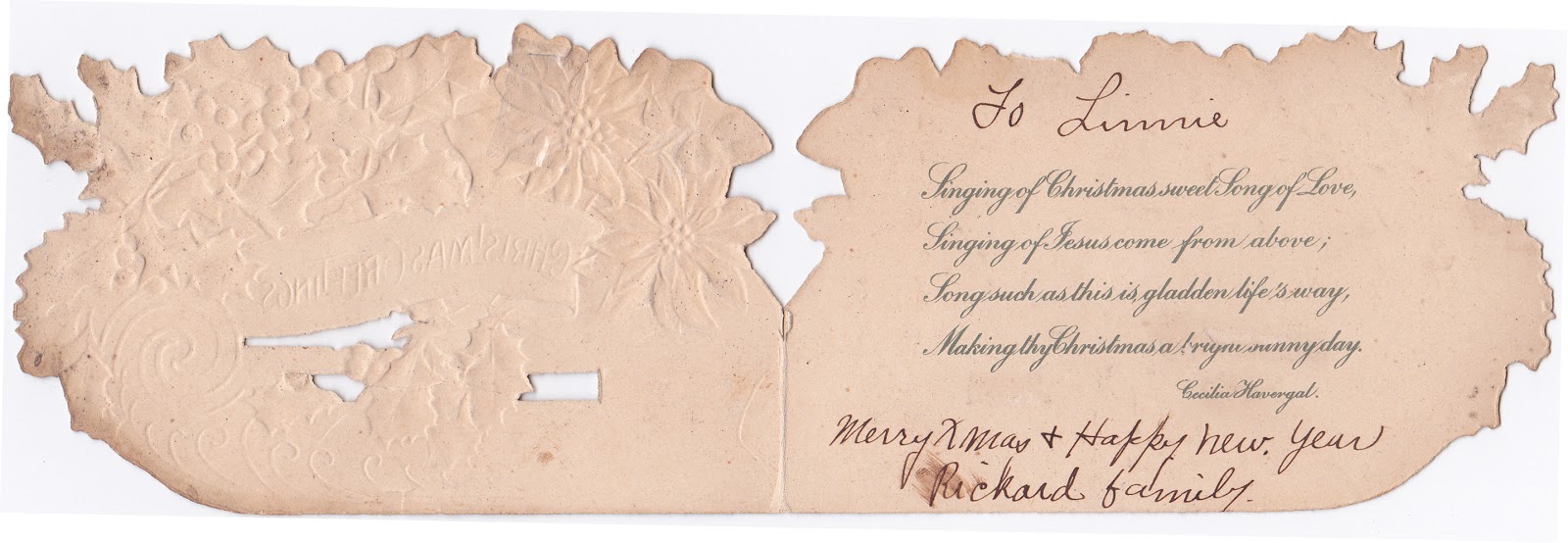
Christmas was the furthest thing from my mind. And then I pulled a hunk of plaster away from the overhead beam, shook the dust and insulation from my head that came with it and saw fall before my eyes something completely out of place and totally unexpected. It was our first Christmas card at the new house.


Thanks to Cecilia Havergal, a Victorian era poet, for the verse, Linnie for sending the card, and the Pickard family for saving the card for me.